Blog » Learn Spanish » Duolingo Alternatives for Spanish: An Honest Guide for Learners Who’ve Hit a Wall

Duolingo Alternatives for Spanish: An Honest Guide for Learners Who’ve Hit a Wall

You’ve been doing Duolingo for months. Maybe even a year. Your streak is impressive. You’ve completed units, earned points, and watched the owl judge you when you skipped a day. Duolingo is a popular language learning app, but there are other apps available for Spanish learners that might better suit your needs.

And yet, when a Spanish speaker actually talks to you, your brain freezes.

You can recognize manzana and gato, but you cannot follow a podcast, cannot easily describe your weekend, and definitely cannot understand your friend’s abuela when she calls.

If that sounds familiar, you are not failing at Duolingo. Duolingo is just not built to take you all the way to where you want to go.

The best Duolingo alternative for Spanish depends on what is actually holding you back. Clozemaster is one of the strongest choices for vocabulary expansion, Dreaming Spanish is excellent for listening comprehension, italki is best for speaking practice, and Babbel is useful for structured grammar. There is no single “better Duolingo.” The right tool depends on your specific bottleneck.

Here’s a quick map before we dig in:

If your problem is…Try…
Vocabulary plateauClozemaster or Anki
You cannot understand native speakersDreaming Spanish or Language Transfer
You cannot actually speakitalki or Tandem
You want structured grammarBabbel or SpanishDict
You want gamified habit with more substanceBusuu or Memrise
You want free resourcesLanguage Transfer, Dreaming Spanish, Anki, or Clozemaster’s free tier

Let’s figure out which one fits your situation as a language learner seeking alternatives.

First, Diagnose Why the Duolingo Language Learning App Is Not Working

Before you switch apps, it helps to understand why you are stuck. Different apps teach language skills in different ways, and Duolingo’s method may not suit everyone. Most Duolingo plateaus come down to three issues.

First, there’s the difference between recognition and production. You might be able to recognize a word or phrase when you see it, but struggle to produce it in conversation. Completing lessons in an app doesn’t always translate to conversational ability, as passive recognition is not the same as active speaking.

Second, there’s the vocabulary ceiling. Duolingo focuses heavily on memorizing words, often through repetition and matching exercises, but may not provide enough context for real usage. This can leave you with a basic vocabulary but little ability to use those words naturally in conversation.

The Vocabulary Ceiling

Duolingo can teach you useful beginner vocabulary, but real Spanish requires much more.

You can finish a large part of the Spanish path and still run into unknown words in the first paragraph of a novel, news article, or social media post. That does not mean you learned badly. It means you need more vocabulary, and you need that vocabulary in real contexts.

Many gamified language learning apps teach words and phrases using audio lessons and video lessons, often featuring native speakers to provide context and real-life usage examples. These platforms often use structured lessons with a clear lessons focus on vocabulary and context, helping you overcome the vocabulary ceiling. Techniques like spaced repetition and flashcards are commonly used to reinforce learning and retention of new words, while multimedia tools such as videos further enhance vocabulary acquisition.

Beginner vocabulary is enough for simple sentences. It is not enough for podcasts, books, movies, jokes, arguments, or casual conversations.

The Recognition-vs.-Production Gap

Duolingo is good at helping you recognize Spanish, especially in multiple-choice or guided exercises.

But recognizing a sentence is not the same as producing it yourself.

Seeing El perro está corriendo and choosing the right translation is one skill. Forming that sentence in real time, while someone is waiting for you to respond, is another skill entirely.

Developing conversation skills requires practicing real conversations and basic conversations, not just memorizing vocabulary or grammar rules. Many language learning apps now incorporate AI technology to provide instant pronunciation feedback, helping learners achieve correct pronunciation, which is crucial for effective communication. Apps designed specifically for conversation practice focus on real-life speaking scenarios and often include simulated conversations to build confidence before real-world interactions.

This is why many learners can complete app lessons but freeze in conversation. They have practiced recognition more than production.

The Context Gap

Duolingo sentences are usually isolated.

You see things like:

La mujer come pan. The woman eats bread.

El niño bebe leche. The boy drinks milk.

These are useful at the beginning, but real Spanish is connected, fast, regional, and full of expressions that do not translate word for word.

For example, ¿Qué onda? does not mean “what wave?” in everyday Mexican Spanish. It means something like “what’s up?”

Unlike Duolingo, some apps focus on real life conversations and encourage you to think directly in the target language, rather than constantly translating from your native language. This approach helps develop practical communication skills for real-world situations.

Visual learners benefit from platforms that provide visual aids and context for vocabulary and grammar, making it easier to understand and remember new concepts. Structured lessons with detailed explanations, along with interactive elements like audio summaries and grammar guidebooks, offer a more comprehensive and engaging learning experience.

Duolingo is useful for absolute beginners building a habit, but many learners hit a plateau after a few months when the app’s limited vocabulary range and lack of real-world context become more obvious.

Once you know your bottleneck, choosing the right alternative gets much easier.

Key Features to Consider in a Spanish Learning App

Choosing the right Spanish learning app can make a huge difference in your progress and motivation. With so many options out there, it’s important to focus on the key features that will actually help you learn Spanish effectively—especially if you’re a serious language learner aiming for real-world skills.

Comprehensive Curriculum: Look for an app that covers all the bases: grammar lessons, vocabulary building, and conversational skills. The best language learning apps don’t just drill you on basic vocabulary—they help you understand grammar rules, build sentences, and use Spanish in real-life situations.

Practice Speaking with Native Speakers: Apps that offer opportunities to practice speaking—whether through speech recognition technology or live conversations with native speakers—are invaluable. Speech recognition can help you practice pronunciation and get instant feedback, while interactive lessons or video calls with real native speakers push you to use your Spanish in context.

Pronunciation Practice and Listening Comprehension: Good Spanish learning apps include pronunciation practice, often with voice recognition or audio comparison tools. Listening comprehension exercises, especially those featuring different Spanish accents, help you get used to the speed and variety of spoken language.

Free Version or Trial Period: Before committing to a paid subscription, check if the app offers a free version or trial. This lets you test the lessons, see if the teaching style fits your learning style, and decide if the app’s features are worth the investment.

Cultural Insights and Specialized Content: The best apps go beyond language mechanics and offer cultural insights—helping you understand not just what to say, but when and why to say it. Some apps also include business language modules or travel phrases, which can be especially useful for serious learners with specific goals.

Progress Tracking and Motivation Tools: Features like progress tracking, daily streaks, and reminders can help keep you consistent. But make sure the app’s gamification supports your learning, rather than distracting from it.

By focusing on these key features—comprehensive lessons, practice speaking, pronunciation feedback, listening comprehension, cultural insights, and a risk-free trial—you’ll be able to choose a Spanish learning app that matches your needs and supports your language learning journey.

Alternatives, Organized by the Problem You Are Solving

“I Want the Habit and Gamification, Just With More Substance”

If the best thing about Duolingo for you is the daily habit, you do not need to abandon that completely. Many Duolingo alternatives offer bite-sized lessons designed for daily practice, letting you learn at your own pace and take as many lessons as you want without restrictions. Several free apps are available, and some even include offline mode for uninterrupted study, making it easy to fit language learning into your schedule wherever you are. In fact, many learners find that combining a gamified app with a more structured course or a speaking-focused platform leads to faster results. You may just need a tool that uses your study time more effectively.

Busuu

Busuu is one of the closest direct alternatives to Duolingo. It offers lessons structured around CEFR levels, such as A1, A2, and B1, so you get a clearer sense of where you stand.

A standout feature of Busuu is its community feedback system. Through its community feature, users can connect with native speakers for real-time corrections and practice. You can submit short writing or speaking exercises for review by native speakers, which leads to more authentic language use. This community feedback not only helps with grammar and vocabulary but can significantly improve your pronunciation and conversational skills.

That kind of correction and interactive community support is something Duolingo does not provide in a meaningful way.

Memrise

Memrise uses spaced repetition and short clips of native speakers. This can be useful if you want to train your ear earlier and hear more natural pronunciation.

It is still app-based and habit-friendly, but the native speaker clips give it a more realistic feel than purely robotic audio.

“I’ve Plateaued on Vocabulary”

This is probably the most common reason people search for Duolingo alternatives.

At some point, you stop needing more beginner sentences and start needing more words, more expressions, and more exposure to how Spanish actually works. Expanding your vocabulary is essential for developing all four core language skills—speaking, listening, reading, and writing—and using audio lessons and video lessons can be especially effective for building these abilities.

Clozemaster

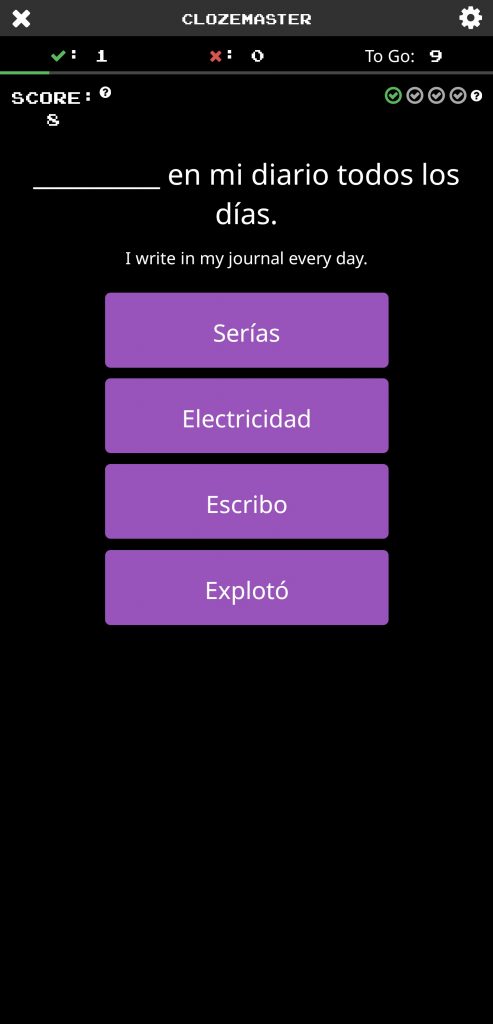
Clozemaster is a vocabulary-learning app built around fill-in-the-blank exercises using realistic sentences. This method is called cloze deletion.

Instead of learning isolated word pairs, you see a sentence with one word missing and fill in the blank:

Mañana voy a la playa con mis ____.
Tomorrow I’m going to the beach with my ____.
Answer: amigos

That simple format is powerful because it forces you to understand vocabulary in context.

Clozemaster is especially useful after Duolingo because:

  • Sentences are based on real Spanish usage, not only textbook-style examples.
  • Vocabulary is organized by frequency, so you can focus on common words before rare ones.
  • Sessions are fast, making it easy to review many sentences in a short time.
  • You repeatedly see familiar words in new contexts, which helps transfer vocabulary from recognition to active understanding.
  • Listening mode lets you practice by ear, not only by reading.
  • Separate Spanish collections are available, including Spanish from Spain and Spanish from Mexico, so you can choose your dialect more intentionally.

Clozemaster is designed for learners who already know the basics — roughly the level of someone who has spent a few months with Duolingo, Babbel, or another beginner course — and now needs to expand vocabulary toward real fluency.

If your problem is “I know the words in my app, but real Spanish still overwhelms me,” Clozemaster is one of the most efficient next steps.

Anki

Anki is the do-it-yourself version.

You make your own flashcards or download decks made by other learners. Its spaced repetition system is extremely effective when used well.

The downside is that Anki has a setup cost. Many learners spend more time adjusting decks than actually studying. It works best if you create cards from real sentences you encounter in books, podcasts, shows, or conversations.

“I Can’t Understand Native Speakers”

If you can read Spanish reasonably well but freeze when someone speaks, you have a listening problem.

The solution is volume: lots of listening at the right level.

Dreaming Spanish

Dreaming Spanish is one of the best tools for listening comprehension. It is based on comprehensible input: watching videos in Spanish that are slightly above your current level but still understandable through context, gestures, images, and repetition.

At first, it may feel slow. Then you realize you watched a full video and understood it without translating in your head.

Dreaming Spanish is especially useful because it gives you a clear path from beginner-friendly content to more natural Spanish.

Language Transfer

Language Transfer is a free audio course that helps you understand how Spanish works. You listen to a teacher guide a student through Spanish grammar and structure.

It is excellent for building intuition and training your ear in a way that written apps cannot.

Clozemaster Listening Mode

Clozemaster can also support listening if you use listening mode. Hearing the sentence first and filling in the missing word by ear trains a much harder skill than simply reading on screen.

Pairing Dreaming Spanish or Language Transfer with Clozemaster listening mode can help connect what you hear to the vocabulary and patterns you are learning.

“I Need to Actually Speak Spanish”

No app will fully teach you to speak Spanish.

You learn to speak by speaking — imperfectly, awkwardly, and repeatedly — with real people. Practicing with real humans is essential for serious language learners who want to speak confidently in real-world conversations. If your goal is to speak with real humans, platforms like italki and Tandem connect you with native speakers. Apps designed specifically for conversation practice focus on real-life speaking scenarios rather than just vocabulary memorization, helping you build practical conversation skills.

italki

italki is one of the most direct paths to speaking practice. You can book lessons with tutors by video call, often at affordable rates.

Even one 30-minute conversation per week can improve your speaking more than months of passive app use.

A tutor can help you:

  • Build confidence
  • Correct repeated mistakes
  • Practice real conversation
  • Learn regional expressions
  • Stop avoiding difficult grammar

Tandem and HelloTalk

Tandem and HelloTalk are language exchange apps. You find a Spanish speaker who wants to learn your language, and you trade practice time.

They are free or low-cost, but less structured than paid tutoring. People may cancel, conversations may drift, and you need discipline to keep the exchange useful.

A strong pattern is to use Clozemaster during the week to absorb vocabulary and phrases in context, then try to use some of those phrases in your italki or Tandem conversations.

That is when words start to stick.

“I Want Structured Grammar Instruction”

If Duolingo’s “guess the pattern” approach frustrates you, you may need a tool that explains grammar more directly. Many Duolingo alternatives for Spanish offer structured lessons and detailed explanations, providing a curriculum-based approach similar to a traditional classroom. These platforms provide structured paths adapted for digital use, where lessons are designed to build upon each other gradually, starting from basic concepts and advancing to more complex structures. Structured lessons in these language learning apps often include a focus on grammar, vocabulary, and pronunciation, offering a comprehensive approach to language acquisition.

Babbel

Babbel is built around explicit grammar explanations and structured lesson progression. It is less playful than Duolingo, but often more satisfying for learners who want to understand why Spanish works the way it does.

It can be especially helpful for topics like:

  • Por vs. para
  • Preterite vs. imperfect
  • Reflexive verbs
  • Object pronouns
  • Subjunctive basics

SpanishDict

SpanishDict has a strong free grammar reference. It is useful when you need a clear explanation, conjugation chart, or example sentence.

It should not be your entire learning routine, but it is an excellent support tool.

Pimsleur

Pimsleur is an audio course built around call-and-response practice and comprehensive audio lessons. It offers offline mode, allowing for uninterrupted study even without an internet connection. While it is slower and more expensive than many apps, Pimsleur is best for immersive speaking practice and helps learners achieve correct pronunciation through its focus on spoken language.

If you want structured speaking practice without staring at a screen, Pimsleur can be helpful.

Overcoming Obstacles on Your Spanish Journey

Learning Spanish isn’t always smooth sailing. You’ll face obstacles—whether it’s tricky grammar rules, struggling to understand native speakers, or feeling nervous about speaking out loud. The good news? Every language learner faces these challenges, and there are practical ways to overcome them.

Break Down Big Challenges: If grammar rules are overwhelming, focus on one at a time. Master the present tense before moving on to the past, or tackle tricky pronouns in small doses. Small, consistent steps add up over time.

Practice Speaking and Listening Daily: The only way to get comfortable with real Spanish is to practice speaking and listening as much as possible. Even a few minutes a day—chatting with a language partner, repeating phrases out loud, or listening to native speakers—can make a big difference.

Use Additional Resources: Don’t be afraid to supplement your main app with other resources. Grammar guides, language exchange websites, and Spanish podcasts can help you see the language from different angles and reinforce what you’re learning.

Embrace Mistakes: Making mistakes is not just normal—it’s necessary. Every error is a chance to learn and improve. Native speakers appreciate your effort, and the more you practice speaking, the more confident you’ll become.

Be Patient and Persistent: Progress in Spanish learning isn’t always linear. Some days you’ll feel stuck, but if you keep showing up, you’ll break through. Be kind to yourself, celebrate small victories, and remember that every step forward counts.

By breaking obstacles into manageable pieces, practicing regularly with native speakers, and staying patient with yourself, you’ll keep moving forward on your Spanish learning journey—no matter what challenges come your way.

The Post-Duolingo Intermediate Stack: About 45 Minutes a Day

This stack is designed for intermediate learners who have finished Duolingo or plateaued around the high-beginner/intermediate level, and it can also benefit advanced learners seeking to maintain or further improve their Spanish skills.

Daily:

  • 20 minutes of Clozemaster to expand vocabulary through sentences
  • 20 minutes of Dreaming Spanish to train listening comprehension with audio lessons as a key component of your routine

Weekly:

  • One 30-minute italki lesson to practice speaking

This stack helps you move from app Spanish toward real Spanish.

The Busy Beginner Stack: About 20 Minutes a Day, Mostly Free

This is ideal for beginners with limited time and budget, as it incorporates audio lessons and bite-sized lessons for efficient learning.

Daily:

  • 15 minutes of Language Transfer until you finish the course
  • 5 minutes of Memrise, Duolingo, or another vocabulary habit tool

After finishing Language Transfer, swap in Clozemaster’s free tier and keep the daily habit going.

The Conversation-Focused Stack: About 30 Minutes a Day + Weekly Calls

This is for learners who want to speak Spanish for travel, work, friends, or family, and are focused on building conversation skills through real conversations, basic conversations, and audio lessons.

Daily:

  • 15 minutes of Pimsleur or another audio-speaking tool for audio lessons that simulate real conversations
  • 15 minutes of Clozemaster focused on common conversational vocabulary and practicing basic conversations

Effective conversation practice apps often include features that allow users to engage in simulated conversations, helping to build confidence before real-world interactions.

Weekly:

  • One or two italki, Tandem, or HelloTalk conversations to practice real conversations

You can skip deep grammar study at first if your main goal is basic conversation. Just make sure you are actually speaking regularly.

When to Stick With Duolingo

Duolingo is not bad. It is just narrow.

Using Duolingo is effective for beginners, especially in your first one to three months of Spanish. It helps you build a daily habit, learn basic words, and get comfortable seeing Spanish every day. However, completing lessons alone is not enough for fluency—it’s important to practice speaking regularly in addition to app-based learning.

Stick with Duolingo if:

  • You are a true beginner
  • You enjoy it and it keeps you consistent
  • You are using it for light maintenance
  • You are not expecting it to make you fluent by itself

Switch or supplement if:

  • You have been using it for several months and feel stuck
  • You can complete lessons but cannot hold a basic conversation
  • You cannot understand native speakers at all
  • The gamification feels more manipulative than motivating
  • You keep reviewing content that feels too easy

The goal is not to delete Duolingo out of guilt. The goal is to stop expecting one beginner app to do everything.

Latin American vs. Castilian Spanish

This does not always get enough attention, but it matters.

The Spanish you study shapes the Spanish you understand.

Duolingo, Babbel, and Pimsleur generally lean toward Latin American Spanish. Language Transfer’s Spanish course uses more Castilian Spanish, including features like vosotros and the “th” sound for c and z in much of Spain.

Dreaming Spanish includes speakers from different Spanish-speaking countries, which is closer to real-world exposure.

If you are planning to live in or visit a specific country, start including content from that region as soon as you are past the basics. The grammar is mostly shared, but rhythm, vocabulary, pronunciation, slang, and listening difficulty can vary a lot.

For example:

EnglishSpainLatin America
Carcochecarro / auto
Computerordenadorcomputadora
You allvosotrosustedes
What’s up?¿Qué tal?¿Qué onda? / ¿Qué más? / regional variants

You do not need to panic about dialects. Just be aware of them and choose content that matches your goals.

The Bottom Line

If you searched for Duolingo alternatives for Spanish, you probably already know Duolingo is not getting you where you want to go.

The mistake is thinking another single app will solve everything. It will not.

Diagnose your actual bottleneck first. Is it vocabulary, listening, speaking, grammar, or consistency? Then choose the tool that solves that specific problem.

If your bottleneck is vocabulary — if you have hit the “I know the Duolingo words but freeze when I see real Spanish” wall — Clozemaster is one of the fastest ways through. Its cloze format gives you repeated exposure to realistic sentences, helping vocabulary move from recognition to usable understanding.

Pick one thing. Change one variable. Keep going.

The streak that matters is not the one inside an app. It is the months you keep showing up.

This post was created by the team at Clozemaster with the help of AI, and edited by Adam Łukasiak.

Leave a Comment

Your email address will not be published. Required fields are marked *