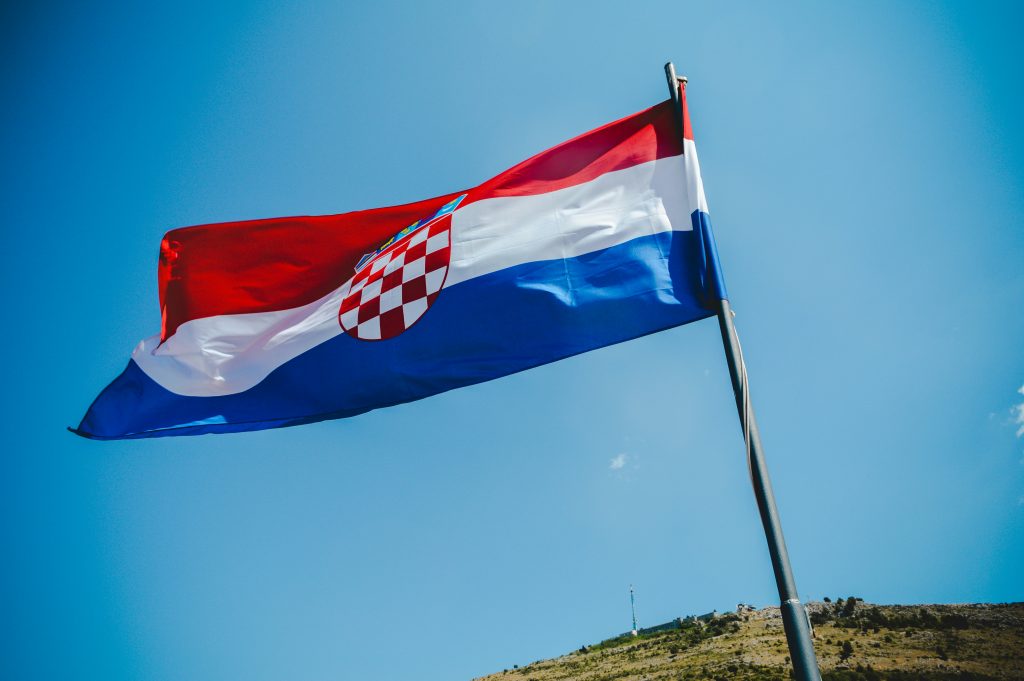
The most effective way to learn Croatian vocabulary is through sentence-based contextual learning, prioritizing high-frequency words first. Unlike languages with simpler grammar, Croatian’s seven grammatical cases mean that words change form depending on their role in a sentence—making isolated flashcard memorization significantly less effective than learning words within complete sentences.
Croatian is part of the Slavic languages family, so learning it can make it easier to pick up other Slavic languages such as Serbian, Bosnian, or Montenegrin.
If you want to learn Croatian vocabulary in a way that actually sticks, you need methods that match how Croatian works. Croatian uses the Latin script, which is an advantage for English speakers compared to other Slavic languages that use Cyrillic.
Croatian vocabulary can feel like a moving target. Just when you think you’ve learned grad (city), you encounter grada, gradu, gradom, gradovi, gradova—and suddenly one word has become six. This isn’t your imagination making things harder. Croatian genuinely requires a different approach than learning Spanish or French vocabulary. Croatian also has a phonemic spelling system, making reading easier than in many other languages.
Learning Croatian as a new language exercises your brain, boosts cognitive abilities, and opens up opportunities since Croatian is an official EU language. It can also enhance your travel experience, helping you discover hidden gems off the tourist path and making it easier to learn other languages in the future.
The good news? Once you understand what makes Croatian vocabulary challenging, you can choose methods that work with the language instead of against it.
Quick Answer: What Is the Best Way to Learn Croatian Vocabulary?
If you’re looking for the fastest and most effective way to learn Croatian vocabulary, focus on these four principles:
- Learn Croatian words in sentence context, not isolation
- Prioritize high-frequency Croatian vocabulary first
- Use spaced repetition with full sentences
- Include native Croatian audio in your study routine
Using the best resources and right resources, such as language learning apps and platforms that offer interactive exercises and instant feedback, can further accelerate your vocabulary learning. Interactive lessons and exercises, which provide immediate feedback, are key features of effective Croatian language learning platforms.
Below, I’ll explain why these approaches work so well for Croatian and how to use them in practice.
Why Croatian Vocabulary Is Harder Than Spanish or French
Croatian vocabulary is more challenging than Romance languages primarily because of its case system—every noun, adjective, and pronoun changes form based on grammatical function. Croatian’s complex grammar system includes seven cases and three genders, making it even more demanding to master. This means “knowing” a Croatian word requires recognizing it in multiple forms, not just one.
Before diving into methods, let’s address why generic vocabulary advice often fails for Croatian learners. To succeed, it’s important to start learning grammar early, especially by analyzing sentences to understand structure and navigate the complex grammar effectively.
The Case System Changes Everything
Croatian has seven grammatical cases, and every noun, adjective, and pronoun changes form depending on its role in the sentence. Take a simple word like žena (woman):
| Case | Example | Translation |
|---|---|---|
| Nominative | Žena je lijepa. | The woman is beautiful. |
| Accusative | Vidim ženu. | I see the woman. |
| Dative | Dajem ženi poklon. | I’m giving the woman a gift. |
| Instrumental | Idem sa ženom. | I’m going with the woman. |
In Spanish, mujer stays mujer regardless of whether she’s doing the action or receiving it. In Croatian, “knowing a word” means recognizing it in multiple forms—which has huge implications for how you should study.
Key insight: If you learn Croatian vocabulary from isolated flashcards, you’ll know žena but freeze when you hear ženom. Sentence-based learning solves this by exposing you to Croatian words in their natural grammatical contexts.
Verb Aspects Will Confuse You (At First)
Croatian verbs come in aspect pairs—imperfective (ongoing action) and perfective (completed action). Pisati and napisati both mean “to write,” but they’re used in different situations:
- Pišem pismo. (I’m writing a letter.) — Imperfective, action in progress
- Napisao sam pismo. (I wrote/have written the letter.) — Perfective, completed
Should you learn both at once? My recommendation: don’t. Learn whichever form appears most frequently first, and let the partner come later through exposure. Trying to memorize pairs from day one leads to confusion and slower progress.
Gender Isn’t Always Predictable
Unlike Spanish, where words ending in -o are usually masculine and -a usually feminine, Croatian has three genders with less obvious patterns. Most (bridge) is masculine. Noć (night) is feminine. More (sea) is neuter. You simply have to learn the gender with each noun.
This means when you encounter a new Croatian word, you need to store it with its gender from the start. Seeing the word in a sentence helps—lijepo more tells you more is neuter because of the adjective ending.
Method 1: Learn Croatian Vocabulary Through Sentences
Sentence-based vocabulary learning is the most effective method for Croatian because it simultaneously teaches word meaning, grammatical forms, and natural usage patterns. Learning full sentences helps you understand context and internalize sentence structure.
For example, instead of memorizing the word “jesti” (to eat) in isolation, learn the sentence “Volim jesti jabuke” (“I like to eat apples”). Recognizing familiar words in real-life situations, such as daily activities, can enhance language acquisition.
How It Works
Instead of learning kuća = house from a flashcard, you learn it from a sentence:
Moja kuća je blizu mora. (My house is near the sea.)
Better yet, you encounter kuća in multiple sentences over time:
- Kupili smo novu kuću. (We bought a new house.) — Here it’s kuću, accusative
- U kući je toplo. (It’s warm in the house.) — Here it’s kući, locative
Why This Works for Croatian
Your brain starts recognizing patterns without explicitly memorizing case tables. After seeing u kući, u školi, u sobi (in the house, in the school, in the room), you develop an intuition for the locative case—even if you can’t recite the rules.
You’re also learning how words actually combine in Croatian. You’ll naturally absorb that Croatians say blizu mora (near the sea) with the genitive, not because you memorized “blizu + genitive” but because you’ve seen it enough times.
Practical Implementation: Cloze Exercises
The most effective version of contextual learning is cloze (fill-in-the-blank) exercises. You might see:
Želim naručiti _____ kave. (I want to order _____ of coffee.)
And you need to produce šalicu (a cup), actively recalling the word and using the correct form. This is harder than just recognizing a word on a flashcard—and that difficulty is exactly what makes it effective.
Multiple choice activities are another effective way to test vocabulary and sentence comprehension, allowing learners to engage with Croatian words by selecting the correct option from several choices.
Clozemaster uses this methodology with a database of thousands of Croatian sentences, each organized by word frequency and including audio. The approach is grounded in comprehensible input theory and spaced repetition research—you encounter Croatian words in authentic contexts, with review intervals optimized for long-term retention. For Croatian specifically, this solves the case-form problem: rather than learning kuća in isolation, you encounter it as kuću, kući, and kućom across different sentences, building recognition of all forms naturally.
Many language learning apps also provide detailed feedback on your performance, helping you identify areas for improvement and track your progress. Some apps use speech recognition to give immediate pronunciation feedback, making it easier to practice speaking Croatian accurately.
Method 2: Prioritize High-Frequency Croatian Vocabulary
Learning Croatian vocabulary by frequency order is highly effective because the most common 1,000 Croatian words cover approximately 85% of everyday conversation, while the top 3,000 words cover roughly 95%.
For daily practice, consider using spaced repetition system apps like Anki, Memrise or Clozemaster, which are effective methods for learning Croatian vocabulary. These apps allow you to study at your own pace and offer progress tracking features, so you can monitor your advancement and stay motivated as you learn.
Not all Croatian vocabulary is equally useful. The word zakonodavstvo (legislation) exists, but you probably don’t need it in your first year of Croatian.
What High-Frequency Croatian Vocabulary Looks Like
The most common Croatian words include predictable items like biti (to be), imati (to have), and da (yes/that). But there are also high-frequency words that textbooks often skip:
- Baš — exactly, really, quite (used constantly in spoken Croatian)
- Već — already
- Još — still, yet, more
- Nego — than, but
- Čak — even
These small words appear in almost every conversation, but traditional curricula bury them in later chapters if they cover them at all.
How to Use Frequency Lists
You can find Croatian frequency lists online, but here’s the honest truth: staring at a list of words in frequency order is boring and ineffective. What works better is using frequency as an organizing principle for sentence-based learning.
This means starting with sentences containing the most common Croatian words, then gradually working toward less frequent vocabulary. You ensure your limited study time goes toward maximum comprehension gains.
Method 3: Use Spaced Repetition With Croatian Sentences
Spaced repetition helps you learn Croatian vocabulary faster when the review material includes full sentences instead of isolated words. Tools like Clozemaster are especially effective here because they combine sentence-level exposure with frequency-based ordering and repeated recall in context.
If you review only dictionary forms, you memorize something that doesn’t look like real Croatian. But if your review includes multiple sentence examples, your brain gets repeated exposure to the actual forms you’ll hear and read.
For beginners, the ‘Drip-Feed’ strategy—studying for just 5–15 minutes daily—can be especially effective. Integrating vocabulary practice into your daily life and engaging in regular speaking practice, such as through courses with expert instructors, can further reinforce your learning.
The best spaced repetition approach for Croatian is:
- short daily sessions
- sentence-based review
- frequent exposure to case forms
- active recall instead of passive rereading
This is one reason sentence-first platforms work especially well for Croatian learners.
Method 4: Include Native Croatian Audio
If you want to learn Croatian vocabulary effectively, you need to hear it—not just read it.
Learning from native speakers is essential for mastering authentic pronunciation and understanding cultural nuances, which are key for real-life communication. Additionally, listening to Croatian music and watching Croatian shows can help reinforce vocabulary and pronunciation.
Croatian pronunciation affects comprehension more than many learners expect. A word that looks manageable on the page can feel completely unfamiliar when spoken quickly.
Why Audio Matters
Croatian has:
- consonant clusters that can feel dense to beginners
- vowel clarity that matters for meaning
- stress patterns that affect recognition
If you only study Croatian vocabulary through text, you may build reading knowledge without listening comprehension.
Best Types of Audio for Croatian Vocabulary Learning
For beginners:
- HRT news broadcasts
- Croatian-dubbed children’s shows
- Croatian songs with lyrics
For intermediate learners:
- Croatian radio
- TV dialogue with subtitles
- podcasts with slower, standard speech
The important thing is consistency. Hearing Croatian words repeatedly helps connect spelling, sound, and meaning into one memory.
Method 5: Use Croatian Input, But Start at the Right Level
“Just immerse yourself” is common advice, but for Croatian learners, it needs a reality check.
Adapting your approach to your learning style can make your language learning journey more effective. Using real-world techniques, such as scanning street signs or switching Netflix shows to Croatian subtitles, can enhance language learning. Watching Croatian shows with subtitles helps connect spoken language to written words. Engaging in micro-activities, like scanning street signs or checking food labels, can make learning Croatian feel more like play than study.
The Croatian Content Problem
Compared to Spanish or French, there is less beginner-friendly Croatian content. Croatian TV, films, and podcasts can feel overwhelming below intermediate level.
What Actually Works for Input
For beginners:
- HRT (Croatian public television) news broadcasts use clear, standard Croatian
- Croatian-dubbed Peppa Pig or similar children’s content
- Croatian song lyrics for repeated listening
For intermediate learners:
- HRT Radio 1
- RTL Croatia
- Croatian crime dramas and news-style content
The Foundational Vocabulary Threshold
You need approximately 1,500–2,000 Croatian words before most native Croatian content becomes useful rather than frustrating. This is why vocabulary building comes first. Once you have that base, input becomes much more effective.
How Long Does It Take to Learn Croatian Vocabulary?
With consistent daily practice using effective methods, most learners can acquire functional Croatian vocabulary (1,500+ words) within 6–12 months.
Here are realistic timelines based on study intensity:
| Daily Study Time | 6 Months | 12 Months |
|---|---|---|
| 15–30 minutes | ~500–800 words | ~1,500 words |
| 1 hour | ~1,000–1,500 words | ~3,000 words |
| 2+ hours | ~2,000+ words | ~4,000+ words |
These timelines assume you are using methods that actually work for Croatian: sentence-based learning, native audio, and consistent review.
Staying motivated and following structured lessons are key to making steady progress on your learning journey.
How Many Croatian Words Do You Need to Know?
To speak Croatian comfortably, most learners need around 2,500–3,000 words. To understand most native Croatian content, aim for 5,000+ words.
Here’s a practical breakdown:
- 500 words: survival Croatian, travel basics
- 1,500 words: everyday conversation on familiar topics
- 3,000 words: solid intermediate Croatian
- 5,000+ words: comfortable understanding of native Croatian media
If your goal is to learn Croatian vocabulary for real conversations, 1,500 words is your first major milestone.
A Simple Croatian Vocabulary Study Plan
If you want a practical way to learn Croatian vocabulary, this is a good starting routine:
Various study methods, including language learning apps and flashcard apps like Anki and Memrise, can supplement your routine. These flashcard apps use spaced repetition to improve vocabulary retention. Additionally, Ling offers chat-based lessons that allow you to practice Croatian conversations at your own pace.
Daily
- 15–20 minutes of sentence-based vocabulary study (using tools like Clozemaster, Anki, or Memrise)
- 5–10 minutes of Croatian listening
Weekly
- review the words you saw most often
- reread or relisten to old material
- add only a small number of new words
Focus areas
- common Croatian verbs
- everyday nouns in multiple case forms
- high-frequency connectors and particles
- useful phrases you hear repeatedly
This kind of routine works better than long, irregular cram sessions.
Common Mistakes When Learning Croatian Vocabulary
Mistake 1: Learning Croatian Words in Isolation
This is the biggest mistake. Croatian words change form too much for isolated memorization to work well.
Mistake 2: Ignoring Case Forms
You don’t need to memorize full tables immediately, but you do need repeated exposure to Croatian words in different sentence roles.
Mistake 3: Skipping Audio
If you never hear Croatian words spoken naturally, your listening skills will lag behind your reading.
Mistake 4: Studying Inconsistently
Fifteen minutes every day beats two hours once a week.
Mistake 5: Trying to Perfect Every Word Before Moving On
Croatian vocabulary grows through repeated contact. You don’t need perfect mastery before learning the next word.
FAQ: Best Ways to Learn Croatian Vocabulary
What is the best way to learn Croatian vocabulary?
The best way to learn Croatian vocabulary is through sentence-based contextual learning, high-frequency vocabulary study, spaced repetition, and native audio.
Why is Croatian vocabulary difficult?
Croatian vocabulary is harder because nouns, adjectives, and pronouns change form across seven grammatical cases, so one word appears in multiple forms.
How many Croatian words do I need to be conversational?
Most learners need around 2,500–3,000 Croatian words for comfortable conversation.
Should I use flashcards for Croatian vocabulary?
Yes, but sentence-based flashcards work much better than single-word cards because Croatian grammar changes word forms constantly.
Is Croatian vocabulary harder than Spanish?
For most English speakers, yes. Croatian’s case system and grammatical complexity make vocabulary acquisition less straightforward than in Spanish or French.
Summary: What Actually Works for Croatian Vocabulary
The best ways to learn Croatian vocabulary are:
- learning Croatian words in complete sentences
- focusing on high-frequency vocabulary first
- using spaced repetition with sentence review
- including native audio every day
- staying consistent over time
Croatian is challenging, but it becomes much more manageable once you stop treating it like a language where single-word memorization is enough.
Ready to try sentence-based Croatian vocabulary learning? Clozemaster’s Croatian course includes thousands of sentences organized by frequency, with audio and built-in spaced repetition—designed specifically for the kind of contextual learning that works for highly inflected languages like Croatian.
This post was created by the team at Clozemaster with the help of AI, and edited by Adam Łukasiak.

